Instructions
- In a large mixing bowl, combine the warm water, sugar, and yeast. Stir gently and let it sit for 5-10 minutes, or until the mixture becomes foamy. This indicates that the yeast is active.
- Add the salt and 3 cups of flour to the yeast mixture. Stir with a wooden spoon or a sturdy spatula until a shaggy dough forms and all the flour is incorporated. The dough will be sticky.
- Turn the dough out onto a lightly floured surface. Knead the dough for about 5-7 minutes. If the dough is too sticky, add a little more flour, one tablespoon at a time, until it’s manageable but still soft. The dough should become smooth and elastic.
- Lightly grease a clean bowl with butter. Place the kneaded dough in the bowl, turning it once to coat the top. Cover the bowl with plastic wrap or a clean kitchen towel and let it rise in a warm place for 1 to 1.5 hours, or until it has doubled in size.
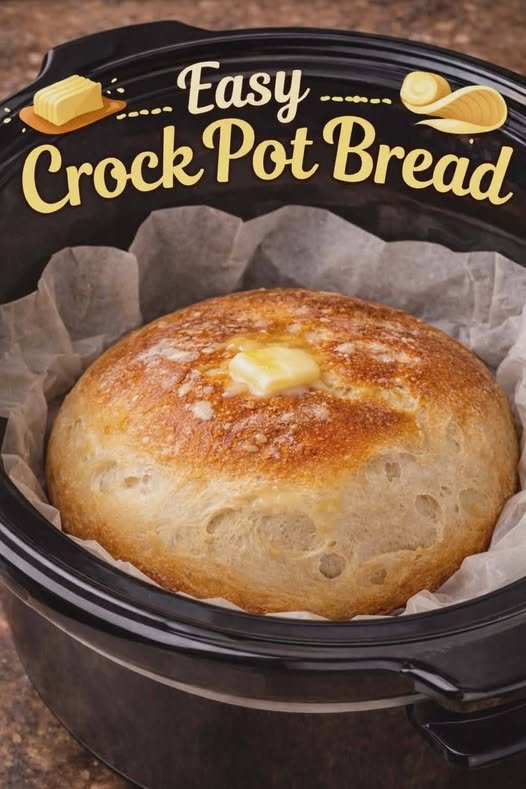
- While the dough is rising, prepare your slow cooker. Cut a large piece of parchment paper to line the bottom and extend up the sides of your slow cooker, creating a “sling” to easily lift the bread out later. You may need to use two pieces, overlapping them, to ensure full coverage. Lightly grease the parchment paper with butter.
- Once the dough has doubled, gently punch it down to release the air. Turn the dough out onto a lightly floured surface and gently shape it into a round loaf. Try not to overwork the dough at this stage.
- Carefully transfer the shaped dough into the prepared slow cooker, placing it on top of the parchment paper.
- Cover the slow cooker with its lid. If your lid has a vent, cover it with a small piece of aluminum foil to keep the moisture in.
- Cook on the HIGH setting for 1.5 to 2.5 hours. The cooking time can vary depending on your slow cooker, so keep an eye on it. The bread is done when it’s firm to the touch, sounds hollow when tapped on the bottom, and an instant-read thermometer inserted into the center registers around 200-210°F (93-99°C).
- During the last 30 minutes of cooking, you can brush the top of the bread with the melted butter. This helps to give it a slightly richer flavor and can contribute to a softer crust. For a slightly crispier top, you can remove the lid for the last 15-20 minutes, allowing some moisture to escape.
- Once cooked, carefully lift the bread out of the slow cooker using the parchment paper sling. Transfer it to a wire rack to cool completely before slicing. This step is crucial, as slicing warm bread can lead to a gummy texture.
Cooking Tips and Variations
For the best results, ensure your yeast is fresh and active. If your water isn’t warm enough, the yeast won’t activate, and if it’s too hot, it can kill the yeast. Aim for bathwater temperature. To prevent a soggy bottom, some slow cooker models benefit from placing a few crumpled balls of aluminum foil or a heat-safe trivet under the parchment paper to lift the bread slightly. This allows for better air circulation. While a traditional crispy crust is hard to achieve in a slow cooker due to the moist environment, you can get a slightly firmer top by cooking without the lid for the last 15-20 minutes, or by briefly popping the cooked loaf under a broiler for 2-3 minutes (if you don’t mind a quick oven detour). Always allow the bread to cool completely on a wire rack before slicing; this allows the internal structure to set and prevents a gummy texture.
Don’t be afraid to experiment with flavor variations! For a savory loaf, try adding 1/2 cup of shredded cheddar cheese and 1 tablespoon of dried chives or rosemary to the dough during the kneading stage. Garlic lovers can incorporate 2-3 cloves of minced garlic or 1 teaspoon of garlic powder. For a touch of sweetness, add 1/4 cup of raisins or dried cranberries along with 1 teaspoon of cinnamon. You can also swap out half of the all-purpose flour for whole wheat flour for a heartier, nuttier loaf, though this may require a bit more water. Consider brushing the top of the loaf with an egg wash (one egg beaten with a tablespoon of water) before cooking for a slightly glossier finish, or sprinkle with sesame seeds or poppy seeds for added texture and flavor.
Storage and Reheating
Once your slow cooker bread has cooled completely, store it at room temperature in an airtight container or a bread bag. It will stay fresh for 3-4 days. For longer storage, you can slice the bread and freeze the slices in a freezer-safe bag for up to 3 months. Thaw frozen slices at room temperature or toast them directly from frozen.
To reheat a whole loaf or larger pieces, you can warm it in a low oven (300°F / 150°C) for about 10-15 minutes, or until heated through. For individual slices, a toaster or toaster oven works perfectly, giving them a lovely, slightly crisp exterior. You can also microwave slices for 10-20 seconds for a quick warm-up, though this might make them a bit chewier.
Frequently Asked Questions
Why is my slow cooker bread not developing a golden crust?
Slow cooker bread is cooked in a moist environment, which typically prevents the formation of a dark, crispy crust like you’d get from an oven. The moisture keeps the bread softer. If you desire a slightly firmer or more golden top, you can try cooking without the lid for the last 15-20 minutes to allow some moisture to escape. Alternatively, for a truly golden crust, you can carefully remove the cooked loaf from the slow cooker and place it under a broiler for 2-3 minutes, watching it very closely to prevent burning. However, this does involve turning on your oven, which defeats the primary purpose of this “no oven” recipe.
Can I use whole wheat flour for this recipe?
Yes, you can substitute some of the all-purpose flour with whole wheat flour. For best results, start by replacing up to half of the all-purpose flour with whole wheat flour (e.g., 1.5 cups all-purpose, 1.5 cups whole wheat). Whole wheat flour absorbs more liquid, so you may need to add an extra tablespoon or two of warm water during the kneading process until the dough reaches the right consistency – soft but not overly sticky. Keep in mind that whole wheat flour tends to produce a denser loaf with a heartier texture than bread made with 100% all-purpose flour.
My bread came out a bit gummy or dense. What went wrong?
A gummy or dense texture can be due to a few factors. One common reason is undercooking; ensure the internal temperature reaches 200-210°F (93-99°C). Another critical factor is not allowing the bread to cool completely on a wire rack before slicing. When bread is still warm, the starches are still gelatinized, and slicing it prematurely can lead to a gummy interior. Always allow at least an hour, or even two, for the bread to cool down fully. Over-kneading can also sometimes lead to a dense texture, as can using too much flour during the kneading process, which results in a stiff dough that struggles to rise properly.